· Markets & Investing · 12 min read
The China Discount: Why the World's Most Hated Stock Market Might Be Its Biggest Bargain
Hong Kong stocks trade at a 50% discount to the S&P 500, and Q1 2026 showed the first signs of awakening. A deep dive into the math, risks, and real numbers.
A story about buying fear, selling greed, and the $10 trillion elephant in the room
TL;DR: The Three Things You Need to Know
- China is on sale. Hong Kong stocks trade at a 50% discount to the S&P 500—you’re paying $10.80 for every $1 of earnings vs. $22.50 in the US. And they’ll pay you 3.5% in dividends while you wait.
- Q1 2026 was the wake-up call. While US markets tanked, China rallied 12.5%. Foreign investors are still mostly out, which means the crowd hasn’t arrived yet.
- This is not a YOLO trade. We’ll walk through exactly how much to buy, what to buy, and how to not get blown up by the risks everyone talks about.
The Setup: A Tale of Two Portfolios
Imagine two investors at the start of 2026.
Sarah in Chicago dumped her life savings into the S&P 500 because, well, that’s what you’re supposed to do, right? American companies, rule of law, Apple and NVIDIA, the whole deal. She paid top dollar—about $22.50 for every $1 those companies were expected to earn in the future. Felt safe. Felt normal.
David in London did something his friends thought was slightly unhinged. He took 10% of his portfolio and bought a basket of Chinese stocks through Hong Kong. Not because he loves China. Not because he trusts Beijing. Simply because the math was screaming at him. He paid $10.80 for every $1 of earnings. Less than half what Sarah paid.
Three months later, Sarah’s “safe” portfolio was down 4.3%. David’s “crazy” bet was up 12.5%.
This isn’t a fairy tale. It’s what actually happened in Q1 2026. And here’s the wild part: even after that rally, David’s stocks are still roughly 40–50% cheaper than Sarah’s. The discount didn’t close. It merely woke up.
The Plot Twist: When the “Safe” Trade Became the Risky One
Let’s be honest. For the past five years, “investing in China” has been a punchline in Western finance circles. The property meltdown, the regulatory crackdowns, the geopolitical tension, the endless “China is uninvestable” hot takes on CNBC. We’ve all heard it.
But markets have a funny way of humiliating the consensus just when it becomes unanimous.
In Q1 2026, while American tech stocks were getting absolutely hammered—the NASDAQ plunged 8.5% in three months as the AI hype finally met reality—Chinese markets quietly staged one of the biggest quarterly rallies in years. The Hang Seng jumped 8.2%. The broader MSCI China Index surged 12.5%. Even the stodgy old CSI 300 (China’s equivalent of the Dow Jones) gained 5.8%.
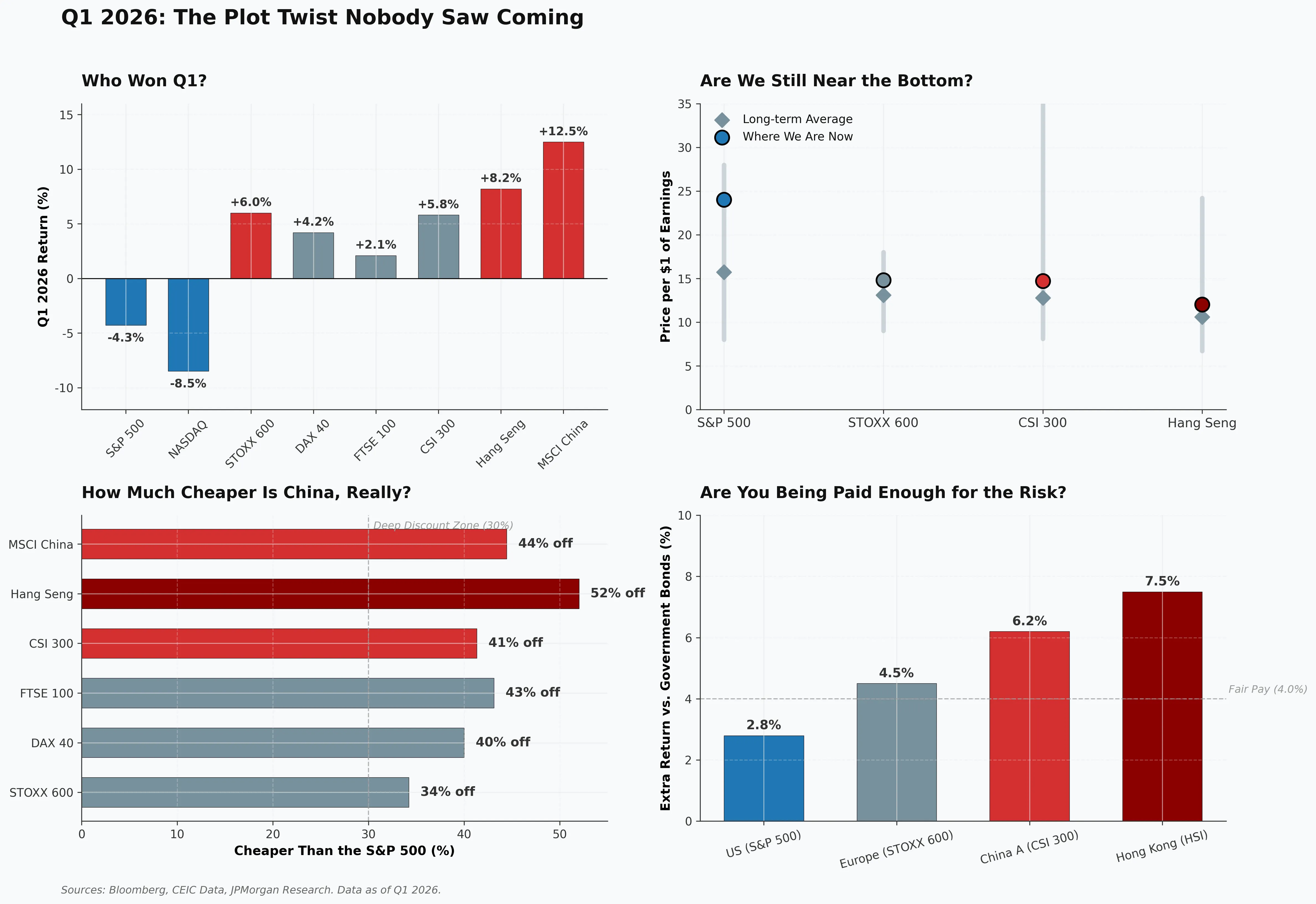
Figure 1: Q1 2026 returns. While US markets corrected, China/HK delivered double-digit gains. The red bars are China/HK; the blue bars are US; the gray bars are Europe.
And here’s what should make you sit up: this rally happened despite the fact that most foreign investors still hate the idea of owning China. The money came from institutional funds and domestic buyers. Foreign retail investors? Still mostly on the sidelines, still mostly skeptical.
In market terms, that’s not the end of a story. That’s often the beginning of one.
The Math That Doesn’t Lie (And Why Your Broker Won’t Show You This)
Let’s strip away the jargon and talk about this like we’re comparing houses.
Suppose you’re house-hunting in two neighborhoods.
Neighborhood A (let’s call it “S&P 500 Heights”) has nice houses. Everyone wants to live there. The average house costs $22.50 for every $1 of rental income it generates. The neighborhood is safe, the schools are good, but you’re paying a massive premium because everyone knows it’s safe.
Neighborhood B (let’s call it “Hang Seng Hollow”) has… well, houses that are a bit rough around the edges. Some people are worried about the local government. There’s been some construction drama. But the average house costs just $10.80 for every $1 of rental income. And oh, by the way, these houses pay you 3.5% in annual dividends just for holding them, while Neighborhood A only pays 1.3%.
Now, would you pay double for Neighborhood A just because it’s more popular? Or would you at least drive through Neighborhood B before making up your mind?
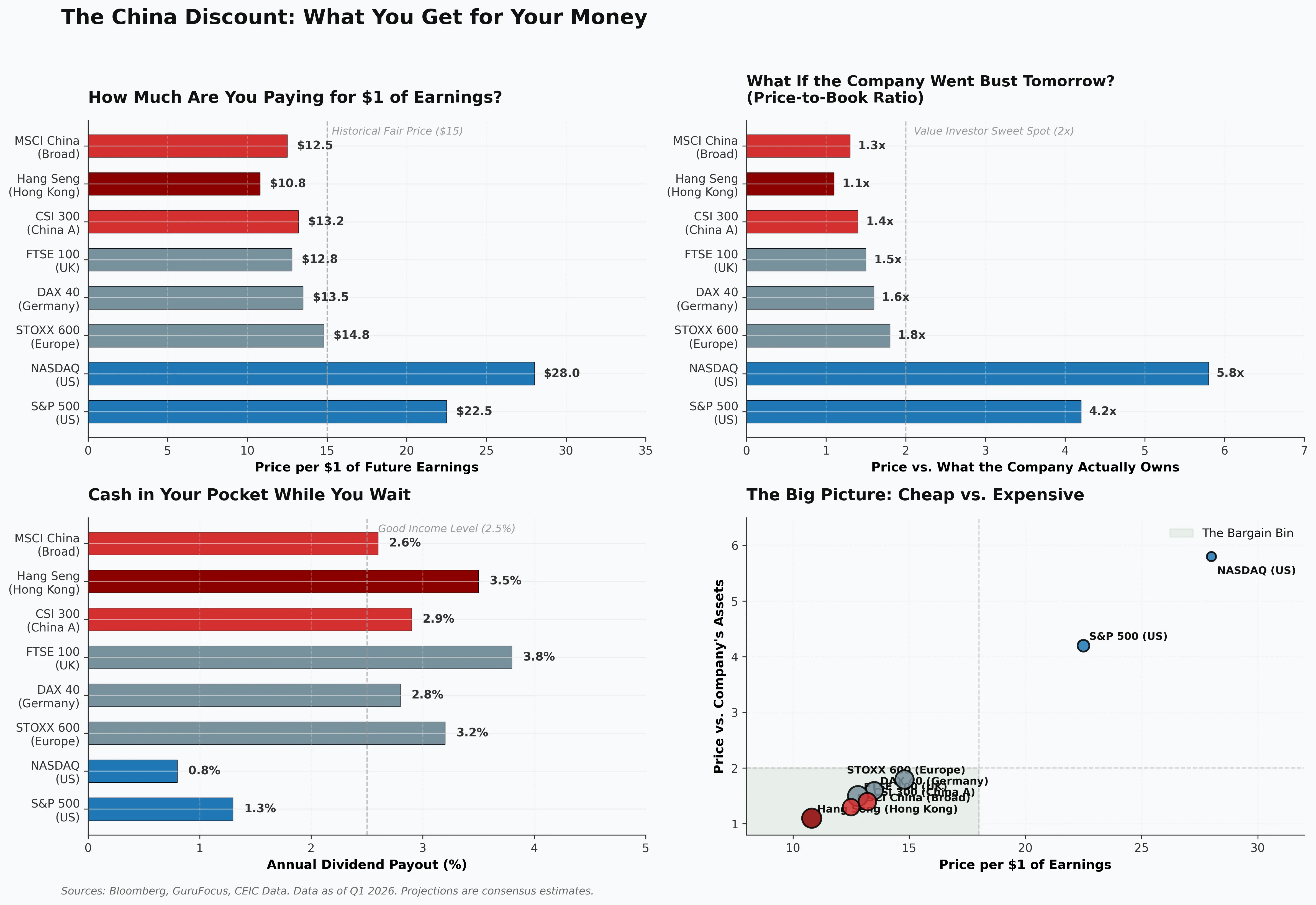
Figure 2: Top-left—how much you pay for $1 of future earnings. Top-right—how much you pay vs. what the company actually owns. Bottom-left—cash dividends while you wait. Bottom-right—the big picture: cheap vs. expensive.
That, in plain English, is the China discount right now. You can see it in the charts above:
- For every $1 of future earnings, you’re paying $22.50 in the US, $14.80 in Europe, and just $10.80 in Hong Kong.
- For every $1 of actual assets (factories, cash, real estate), you’re paying $4.20 in the US and $1.10 in Hong Kong. Let that sink in. Hong Kong stocks are trading at barely above their net asset value.
- While you wait, Hong Kong pays you 3.5% per year in dividends. The S&P 500 pays 1.3%. That’s the difference between a savings account and a checking account.
This isn’t about loving China. This is about not overpaying for popularity.
”But Is It Cheap for a Reason?”
Fair question. And the honest answer is: yes, partly.
China has real problems. The property sector is a mess. Local government debt is concerning. Geopolitical tension with the US isn’t going away. And yes, the government can be unpredictable. Anyone who tells you otherwise is selling something.
But here’s the thing about markets: they don’t ignore problems. They price them. And right now, Chinese stocks are priced as if the apocalypse is imminent.
The Hang Seng’s P/E of 12x isn’t just cheap compared to America. It’s cheap compared to its own history. Over the past 20 years, the Hang Seng has averaged about 10.6x earnings. Today it’s at 12x—barely above average, and miles below the 18x it hit in 2021. The CSI 300 is at 14.7x, just 15% above its long-term average of 12.8x. These aren’t bubble valuations. They’re “everyone gave up” valuations.
Figure 2 (top-right): The gray bars show the historical range of P/E ratios. The blue/red dots show where we are now. Notice that China/HK (red dots) are still near the bottom of their historical ranges, while the S&P 500 (blue dot) is near the top.
Think of it this way: if you’re buying a house in a neighborhood with some crime, you don’t pay the same price as the perfect suburb. You pay less. The question is whether you’re paying enough less to compensate for the risk.
Right now, the market is saying Chinese stocks need to deliver 6–7.5% more annual return than government bonds just to justify their price. US stocks only need to deliver 2.8% more. That’s a massive gap. If you believe China isn’t actually collapsing, you’re being paid handsomely to take that bet.
The Growth Story Nobody’s Talking About
Here’s where it gets really interesting.
Cheap is nice, but cheap and growing is how you make real money. And despite all the doom and gloom, Chinese companies are expected to grow earnings significantly faster than their American counterparts in 2026.
- Chinese tech: 34% annual earnings growth expected. US tech: 11%.
- Chinese healthcare: 22% growth. US healthcare: 9%.
- Chinese consumer companies: 15% growth. US consumer: 8%.
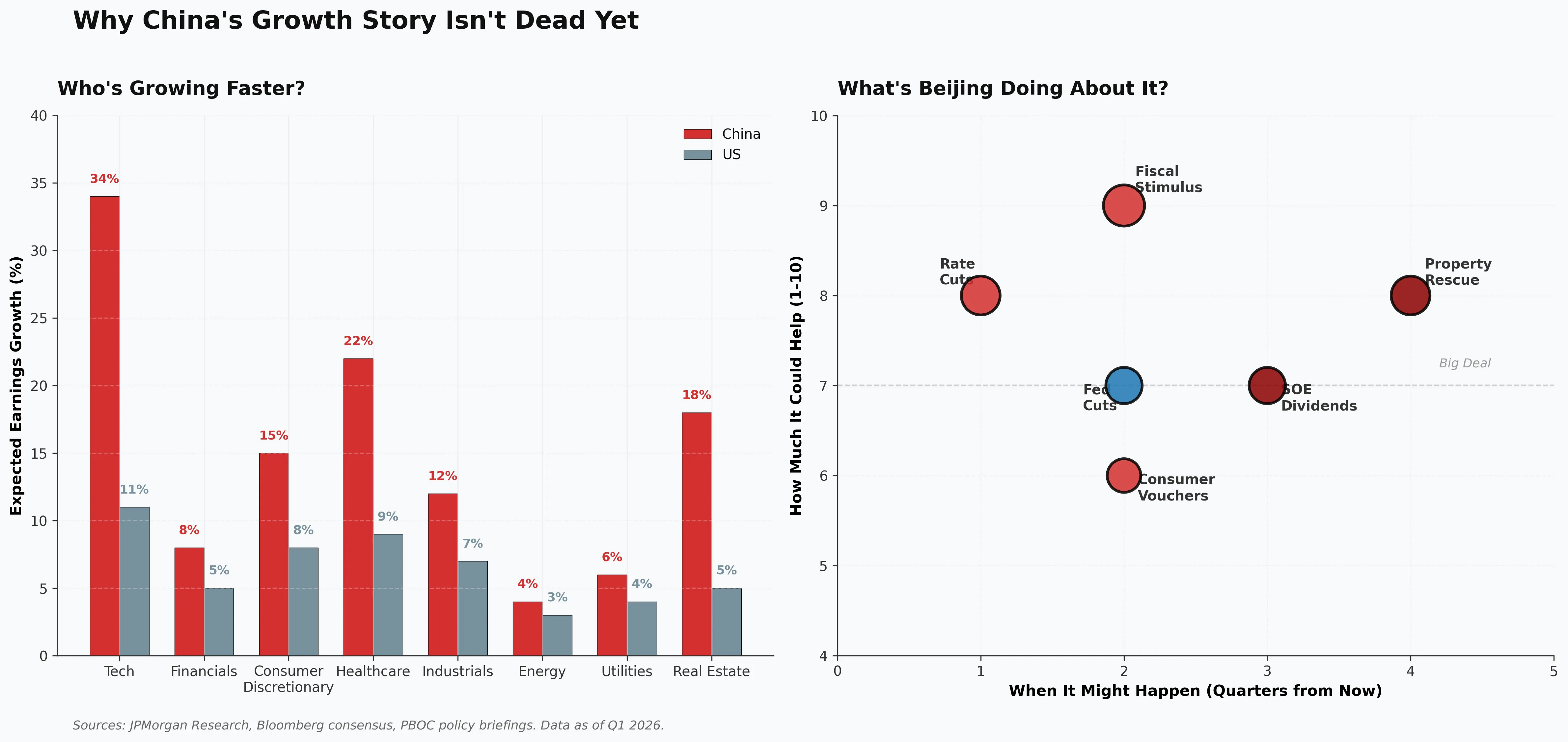
Figure 3: Left—expected earnings growth by sector. China (red) outpaces the US (gray) in almost every category. Right—Beijing’s policy toolbox. The bigger the bubble, the more impactful the policy. The further right, the longer you might have to wait.
Why? Because Beijing is finally doing what investors have been begging for. The People’s Bank of China cut interest rates in January 2026 and is expected to cut more. Fiscal stimulus is flowing. State-owned enterprises are being forced to pay out bigger dividends. And the government is quietly stabilizing the property sector before it becomes a systemic bomb.
Is it enough? Nobody knows. But for the first time in years, the policy wind is at investors’ backs, not in their faces.
”Okay, But How Do I Actually Buy This?”
Great question. Most Western retail investors have no idea how to access Chinese markets. Here are your options, from easiest to slightly more involved:
Option 1: Hong Kong Stocks (The Easy Button) Many Chinese giants—Tencent, Alibaba, BYD, Xiaomi—trade in Hong Kong with English reporting and international accounting standards. If your broker offers Hong Kong exchange access (most major ones do), you can buy these just like Apple or Tesla. No special paperwork.
Option 2: ETFs (The Lazy Smart Way) Don’t want to pick individual stocks? Fine. Buy an ETF that tracks the CSI 300 (ticker: ASHR) or the Hang Seng Index (ticker: 3188.HK). You get instant diversification across 50–300 companies. It’s like buying the whole neighborhood instead of guessing which house will appreciate.
Option 3: Dividend ETFs (The “Get Paid to Wait” Strategy) If you like the idea of collecting 3–5% in cash while you wait for prices to recover, look for ETFs tracking the Hang Seng High Dividend Yield Index. They pay quarterly, and the yields are genuinely attractive in a world where US Treasuries aren’t much better.
One important note: If you’re American, some Chinese ADRs have delisted or face restrictions. Hong Kong-listed shares are generally your safest bet. If you’re European, you have more flexibility through Stock Connect programs.
The Risks: Let’s Not Pretend This Is a Free Lunch
I promised you honesty, not hype. Here are the real risks, and why they matter:
1. Geopolitics Could Blow Everything Up If US-China relations deteriorate sharply—new tariffs, Taiwan tensions, technology sanctions—Chinese stocks could drop 20% in a week. This is the single biggest risk, and it’s impossible to predict. You’re not betting on companies here; you’re partly betting on politicians.
2. The Property Sector Is Still a Dumpster Fire Real estate investment was down 11% year-over-year in early 2026. Developer defaults continue. This isn’t just a stock market problem; it’s a consumer confidence problem. Chinese households have 70% of their wealth in property. If that keeps falling, they won’t spend, and the economy stalls.
3. The Government Can Change the Rules Overnight Remember the 2021 education sector crackdown? Or the tech regulatory blitz? China can and does change regulations suddenly. The 28% foreign ownership ceiling on individual stocks has triggered forced selling before. It could happen again.
4. Currency Risk If the yuan devalues significantly against the dollar or euro, your returns get eroded. The good news: the yuan has been relatively stable. The bad news: it’s managed by a government that can change its mind.
5. Deflation China’s core inflation is around 1.2%. Persistent deflation means companies can’t raise prices, which squeezes profit margins. It’s the silent killer of nominal growth.
These risks are real. But remember: the market knows all of this. That’s why the discount exists. The question isn’t whether China has problems. It’s whether the problems are worse than a 50% discount already implies.
The Bottom Line: What Would I Actually Do?
If I were sitting across from you at a coffee shop and you asked me, “Should I buy China?” here’s what I’d say:
Don’t bet the farm. This isn’t a YOLO trade. It’s a position-sizing exercise. Take 5–15% of your equity portfolio—money you genuinely don’t need for five years—and allocate it to China/HK. That’s enough to matter if the discount closes, but not enough to ruin you if things go sideways.
Buy quality, not speculation. Stick to profitable companies with real cash flows. Tencent, Alibaba, the big banks, consumer staples. Avoid the tiny speculative stocks that make for good Twitter threads but bad portfolios.
Get paid to wait. Prioritize dividend-paying stocks or ETFs. A 3.5% yield means you’re collecting cash even if the share price goes nowhere for a year. That’s your patience premium.
Don’t try to time it. Markets are volatile. Stage your entry over 3–6 months. If China drops 10% next month, that’s not a disaster—that’s a better entry price. Keep some dry powder.
Have an exit plan. Decide in advance what would make you sell. A 50% gain? A specific geopolitical event? A breakdown below a certain valuation? Write it down. Discipline beats conviction in emerging markets.
The Real Question
Here’s the philosophical kicker: if you believe in buying low and selling high, you have to be willing to buy things that feel wrong. That’s the whole point. If it felt comfortable, it wouldn’t be cheap.
China feels wrong right now. It feels risky, uncertain, politically fraught. That’s exactly why it’s cheap. The S&P 500 feels safe, familiar, inevitable. That’s exactly why it’s expensive.
I’m not telling you to love China. I’m telling you to respect the math. And the math says that, for patient investors with a stomach for volatility, the world’s most hated stock market might also be its biggest bargain.
The discount won’t last forever. Either the problems get solved and prices rise, or the problems get worse and prices fall further—at which point the discount becomes even more absurd. Either way, the starting point matters. And right now, the starting point is $10.80 for a dollar of earnings.
Your move.
Important Stuff (Read This Before You Do Anything)
This article is for entertainment and education only. It is NOT financial advice.
I’m not a financial advisor. I’m not licensed to tell you what to buy. I’m just a guy who looks at numbers and finds them fascinating. The analysis here is based on publicly available data and my own interpretation, which could be completely wrong.
Investing in China and Hong Kong involves real risks: you could lose money, you could lose a lot of money, and you could lose it faster than you think. Currency swings, political surprises, and regulatory changes can wipe out gains overnight. Past performance (like that Q1 rally) doesn’t guarantee future results. In fact, it often guarantees the opposite.
Before you invest a single dollar, talk to a qualified financial advisor who understands your personal situation, your risk tolerance, and your tax situation. Don’t YOLO your retirement into Chinese tech stocks because some article on the internet had convincing charts.
Never invest more than you can afford to lose. Seriously.
Data Sources: Bloomberg, GuruFocus, CEIC Data, JPMorgan Research, Simply Wall St, AASTOCKS, Shanghai Stock Exchange, and various broker consensus estimates. All data as of Q1–Q2 2026 unless otherwise noted. Charts created by the author.